




Understanding Drawdown: Daily DD vs Max DD
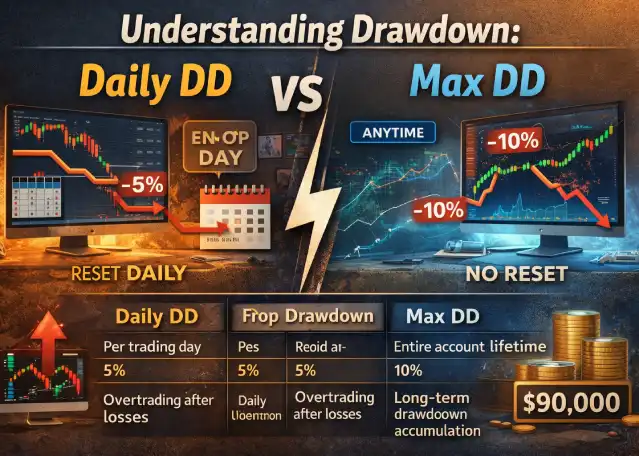
Drawdown rules are one of the most important — and most misunderstood — aspects of prop trading. Many traders fail challenges or lose funded accounts not because of bad strategies, but because they violate daily drawdown (daily DD) or maximum drawdown (max DD) limits.
In this article, we’ll clearly explain what drawdown means, how daily and maximum drawdown differ, and how to manage both effectively when trading with a prop firm.
What Is Drawdown in Prop Trading?
Drawdown refers to the reduction of account equity or balance from a peak to a lower point. In prop trading, drawdown limits are risk control mechanisms designed to protect the firm’s capital.
If a trader exceeds these limits — even temporarily — the account is usually terminated, regardless of past performance.
What Is Daily Drawdown (Daily DD)?
Daily drawdown is the maximum amount a trader is allowed to lose within a single trading day. Once this limit is reached, trading must stop — or the account is breached.
How Daily Drawdown Is Calculated
- Based on balance or equity (depends on the firm)
- Resets every trading day
- Often includes floating (unrealized) losses
For example, if a prop firm allows a 5% daily drawdown on a $100,000 account, the trader cannot lose more than $5,000 in a single day.
Why Daily DD Is Strict
Daily drawdown prevents emotional revenge trading and protects the firm from sudden, high-risk behavior during volatile market conditions.
What Is Maximum Drawdown (Max DD)?
Maximum drawdown is the total loss allowed over the lifetime of the account. Unlike daily drawdown, it does not reset.
How Max Drawdown Works
- Usually calculated from the initial balance or highest equity
- Applies across all trading days
- Permanent limit for the account
For instance, with a 10% max drawdown on a $100,000 account, the account is breached if equity drops below $90,000 at any time.
Daily DD vs Max DD: Key Differences
| Aspect | Daily Drawdown | Maximum Drawdown |
|---|---|---|
| Timeframe | Per trading day | Entire account lifetime |
| Reset | Yes (daily) | No |
| Purpose | Control daily risk | Limit overall losses |
| Common Violation | Overtrading after losses | Long-term drawdown accumulation |
Common Drawdown Mistakes Traders Make
- Ignoring floating drawdown
- Holding losing trades overnight
- Increasing lot size to recover losses
- Not adjusting risk after losing streaks
How to Trade Safely Within Drawdown Limits
Successful prop traders treat drawdown limits as hard rules, not suggestions. Proper risk management is essential.
- Risk only 0.25%–1% per trade
- Set daily loss limits below firm rules
- Use hard stop-loss orders
- Stop trading after consecutive losses
Final Thoughts
Understanding the difference between daily drawdown and maximum drawdown is critical for passing prop firm challenges and keeping funded accounts. Traders who respect drawdown rules survive longer — and get paid.
Related Articles
What is drawdown in prop trading?
Drawdown is the amount an account loses from its peak balance or equity, limited by prop firm rules.
Is daily drawdown based on balance or equity?
It depends on the prop firm. Many use equity-based drawdown, including floating losses.
Does maximum drawdown reset?
No. Maximum drawdown applies for the entire lifetime of the account.
Which drawdown rule is more dangerous?
Daily drawdown causes the most instant failures, while max drawdown quietly accumulates over time.
How can traders avoid drawdown violations?
By reducing position size, setting personal loss limits, and stopping trading after a losing streak.