





https://my.xm.com/research/markets/news/analysis/1795602042944

Dollar retreats as Wall Street pulls back
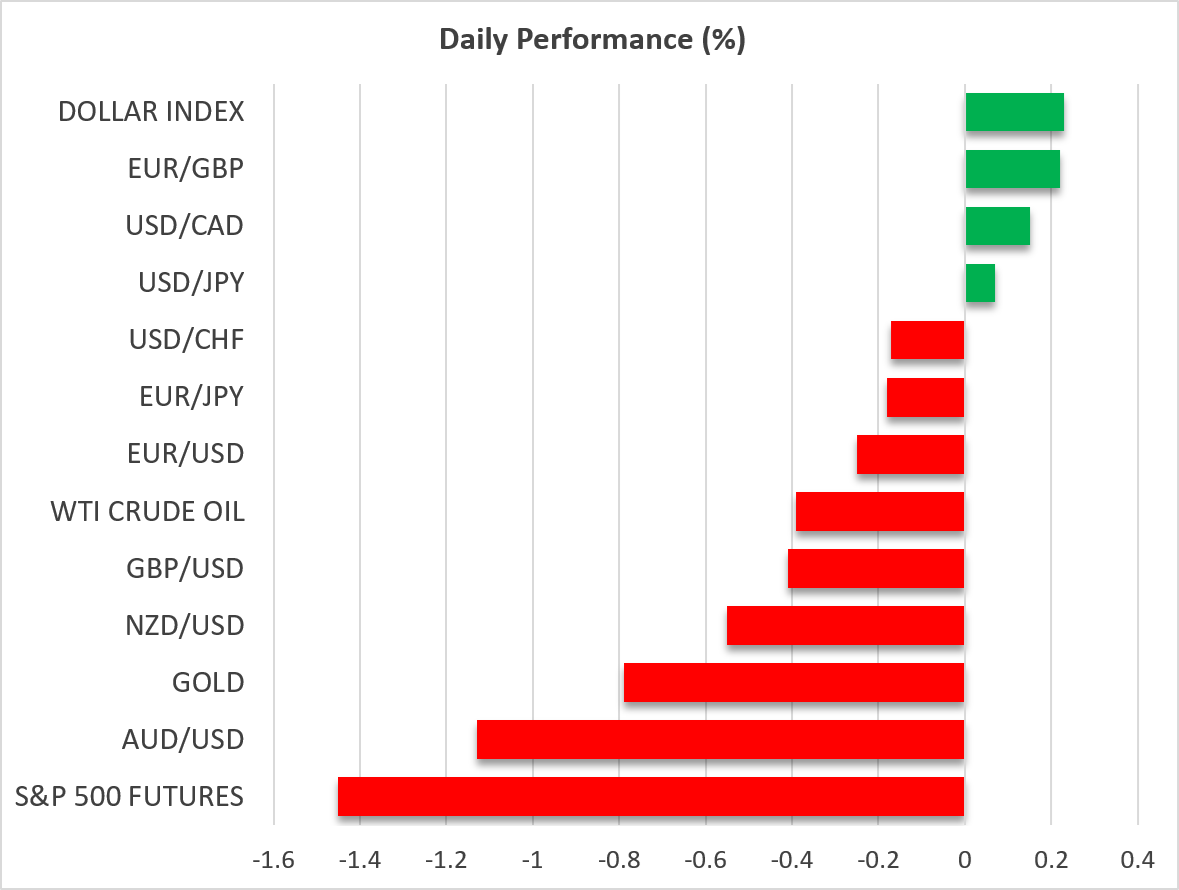
The US dollar retreated against all but one of its major counterparts on Tuesday, gaining some ground only against the yen. The dollar index (DXY) reversed nearly all its Monday gains that led it to a 20-month high, and the main driver appears to be Wall Street.
Stocks pulled back yesterday as enthusiasm for the AI trade faded, prompting traders to reassess the US growth and investment narrative, and thereby recalibrate their Fed rate hike expectations. According to Fed fund futures, a December 25bps rate hike remains fully factored in, but the mere probability of a bigger 50bps increment vanished. On top of that, the basis points worth of rate hikes expected for next year have decreased to around 65.
Someone may get confused as a declining stock market is usually associated with more aggressive hike expectations. However, the distinction comes to which market is the driver. If hike bets increase for whatever reason, Wall Street feels the heat, but when the stock market slides, rate hike bets may be scaled back if the pullback on Wall Street raises questions about growth and investment.
GDP and PCE data come into focus
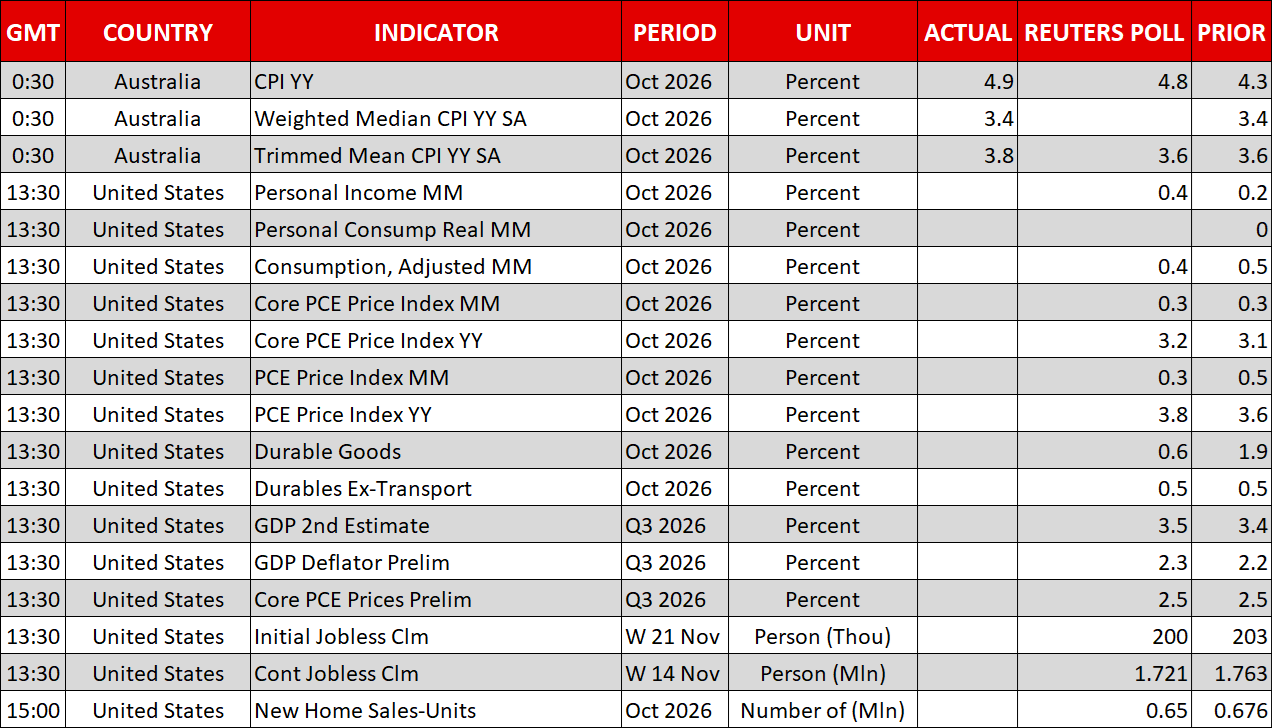
Today, the spotlight is likely to turn to the second estimate of Q3 GDP and the PCE data – the Fed’s favorite inflation metrics – for October. An upward revision to GDP and more signs of inflation not cooling could encourage investors to add more basis points worth of rate hikes back to their calculations for next year, and thus, the US dollar, which is already in recovery mode ahead of the data today, is likely to get another shot in the arm.
Australian dollar slides despite hot inflation
The Australian dollar is bleeding today against the US dollar, even after Australia’s CPI data revealed hotter-than-expected inflation during October. The headline year-on-year rate jumped to 4.9% from 4.3%, while the trimmed mean CPI accelerated to 3.8% y/y from 3.6%.
The aussie strengthened at the time of the release but was quick to surrender those instant gains, continuing to roll downwards as the market remained convinced the RBA is done raising rates amid deteriorating labor market conditions and slowing economic growth. Investors are even expecting two quarter-point rate cuts by the end of 2027.
The reality check stock traders had yesterday after Nvidia pulled back may have also contributed to the weak performance of the risk-linked currency.
Nvidia leads technology shares lower
On Wall Street, both the S&P 500 and the Nasdaq slid, with the latter losing nearly 1.5%. The decline was driven by Nvidia’s nearly 6% retreat, following Monday’s impressive more-than-30% rally triggered by the return of Jensen Huang as CEO amid pressure from US President Trump.
Although Huang’s return eased uncertainty related to Nvidia’s leadership, concerns about corporate governance and political influence remained elevated. On top of that, Huang’s reinstatement does little to help resolve risks related to the sustainability of debt-financed AI investment and massive spending on AI projects. It is worth mentioning that the Philly Semiconductor Index (SOX) dropped around 8%, while Anthropic fell below its IPO price, amid a blend of post-IPO profit taking and concerns about whether its revenue growth can justify its lofty valuation.
The Dow Jones was the only index that ended the session in the green, reflecting a rotation towards more defensive stocks, and suggesting that in the absence of any other safe-haven asset, it may act as a hedge to the other two, more growth-driven, indices.
Another downside risk for Wall Street is the potential announcement of fresh tariffs today. According to headlines, the Trump administration is preparing to release findings of an investigation that proposes tariffs to replace those struck down by the US Supreme Court in February.
Gold resumes its slide
Indeed, gold was once again overlooked, even amid a weaker dollar, corroborating the notion that it has lost its safe-haven appeal. The precious metal resumed its slide following Monday’s recovery, and appears ready to test again the $3,500 zone, which offered support on Friday. A break lower may tempt the bears to test the $3,400 zone, which acted as a consolidation magnet-zone between April and August 2025.


Crypto market drifts lower again to $2.04T
EBC Markets Briefing | Aussie dollar down as short positions pile up

SK Hynix Slides Below $112 as Asian Chip Stocks Reverse
Daily Technical Analysis: Gold Extends Its Downtrend as Prices Break Below $3,530

Dell Rebounds After Hours as Record AI Backlog Lifts Outlook
Daily Fundamental Analysis: Nasdaq and S&P 500 Ease Back, Giving Up Some of Monday’s Strong Gains

Extreme Fear and Bitcoin’s Four-Year Cycle: What Could the Current Downturn Mean?