




Understanding Leverage in Prop Trading
Leverage is one of the most powerful tools in trading — and one of the fastest ways to blow an account. In prop trading, leverage matters even more because you’re trading under strict rules like drawdown limits, daily loss caps, and risk controls.
This guide explains what leverage is, how it works inside prop firm accounts, why different firms offer different leverage, and how to use it without turning your strategy into gambling.
What Is Leverage in Trading?
Leverage means you can control a larger position size with a smaller amount of capital (margin). In simple terms: the broker or firm lets you borrow buying power so you can trade bigger than your cash balance.
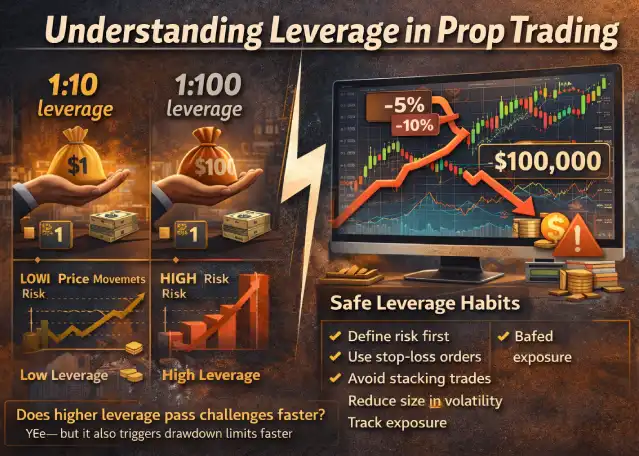
A leverage ratio like 1:10 means every $1 of margin controls $10 of exposure. A ratio like 1:100 means every $1 controls $100 of exposure.
Why Leverage Exists in Prop Trading
Prop firms use leverage to make strategies viable across different account sizes. Without leverage, many short-term strategies (especially on forex and indices) would require huge capital to generate meaningful returns.
But leverage is also a risk accelerator. It can boost profits — and amplify losses — in seconds. That’s why prop firms treat leverage as a controlled feature, not a “free upgrade.”
How Prop Firms Set Leverage Limits
Prop firms typically define leverage by asset class and platform. You might see different leverage for:
- Forex (often higher leverage)
- Indices (usually moderate)
- Commodities (varies widely)
- Crypto (often lower due to volatility)
Firms set these limits to control exposure during spikes, news events, and volatile sessions. Higher leverage isn’t “better” — it’s just more responsibility.
Leverage vs Risk: The Mistake Traders Keep Making
Many traders confuse leverage with risk. Leverage only defines how large you can trade. Risk is how much you choose to lose if the trade goes wrong.
Two traders can have the same account and the same leverage, but completely different risk profiles:
- Trader A uses small position sizes and risks 0.5% per trade
- Trader B maxes exposure and risks 5% per trade
The leverage didn’t cause the blow-up — position sizing did.
How Leverage Interacts With Drawdown Rules
In prop trading, your real enemy isn’t “a losing trade.” It’s a losing trade that violates rules. If you’re trading with high exposure, even a normal pullback can hit daily drawdown (Daily DD) or max drawdown (Max DD).
This is why smart traders treat leverage like a ceiling, not a target. They size positions based on risk limits first, and only then check whether margin allows the trade.
Safe Leverage Habits for Prop Traders
- Define risk per trade first (e.g., 0.25%–1%)
- Use stop-loss orders and assume slippage can happen
- Avoid stacking correlated trades (multiple positions that move together)
- Reduce size during news/volatility instead of “trying to win big”
- Track exposure, not just lot size (especially across pairs/indices)
Does Higher Leverage Help You Pass Faster?
It can — but usually in the worst way. Higher leverage makes it easier to hit profit targets quickly, but it also makes it easier to violate drawdown limits.
Most traders who pass consistently do it with controlled risk, not maximum leverage. The goal is to survive long enough for your edge to play out.
Final Thoughts
Leverage is not a strategy. It’s a tool. In prop trading, the best leverage is the one that supports your plan without pushing you into rule-breaking behavior. If you control risk, leverage becomes useful. If you chase returns, leverage becomes the reason you fail.